This is a gorgeous ambient album that feels so introspective and rich in emotion, qualities I really love when I'm listening to this kind of thing. Due to the nature of this album, I am going to just write this review freely as I listen, with some stream-of-consciousness thoughts and interpretations.
The album begins with high and mysterious piano in the first track "Monochromatical", which quickly (in a relative sense) gives way to low, somber, dark ambient, like a glimpse of the sky before descending into the depths. This continues for the next two tracks ("Wind's Cold Touch" and "Where I Go When I Am Sleeping"), the whole pacing being slow and contemplative. With this opening, it feels like groping around in the dark, but there is only void.
The piano, and thus the sense of self now far removed from the external, returns to the foreground in "The Garden of Forgotten Memories", and it is really beautiful. It has so much atmosphere and allows the sustain to permeate, and the piano stays in the spotlight the very end of the song. And then it continues in "Ephemeral Casket", accompanied by (I'll use the word again) somber string and ambient rumble layers. But the somber quality is not without hope. There's a kind of sad yearning in this music, memories or desires of something better, some hope that refuses to die, no matter how weakened it may be.
"What We Regret" has the piano more subdued again, the string layers coming more to the forefront. This is one of the two tracks on the album with a featured artist other than Cenesthesia, asukrai, another ambient/experimental/drone musician. It's not clear where the collaboration begins and ends, but that's a cool thing to me, I love when a collaboration just seems seamless. But I'm new to both of these artists, so there's that.
When we get to "There Is No Greater Hell Than Isolation", the piano comes back, and perhaps it is the title of this track that makes me think this way but it does feel like the right hand of the piano part is merely dancing intermittently next to the slow, steady left hand wandering, keeping with this theme of feeling isolated for this track. After all, isolation is most obvious when you know there are things all around you that you're being kept from, either by others or by yourself. And this track is long, 9 minutes, the longest track on the album. It is, in some ways, more rigid than anything else thus far on the album, and feels like staring at a clock. I don't mean that to say it's boring, and I don't think it is. I mean that makes the passage of each second feel heavy and all-consuming, especially when it stops for a moment about exactly halfway through. You can feel the clock halt and time stop for that moment. And then the high piano part has been snuffed, put into its true isolation away from us.
The second collaborative track, "Empathetic Misery", follows, this time a collaboration with nihigo. This track (which continues the album's unified sound of expressive, reverb-laden piano and strings and ambiance) has soundscape aspects that aren't present in other tracks, which amount to sounding like the peripheral of a reality. And then, halfway through, the heaviness lets up, and there is this beautiful, tender moment without all the drenched, gloomy reverb. It feels so tender and dynamic. The featured artist nihigo seems to make a lot of soundtrack-type music, and I could totally see that here, as this feels super dramatic and even cinematic. I love this piece quite a lot.
"The Old Story About Sleepless Nights" kind of mirrors the feeling of "The Garden of Forgotten Memories", and I think the titles of these songs really tie into the fact that this is meant to be a very narrative album. One of the tags for this album on Bandcamp is "storytelling". This album (at least so far) has no lyrics or words at all besides the titles of the tracks, but between those and this music, there is indeed a rich story being told here. At least, I feel that's the case. I apologize to the artist if I am misinterpreting any of it, but I do think the nature of more abstract musical storytelling is that we all get something a little different out of it. This kind of music is like a mirror into the soul, and everyone has different stories in there.
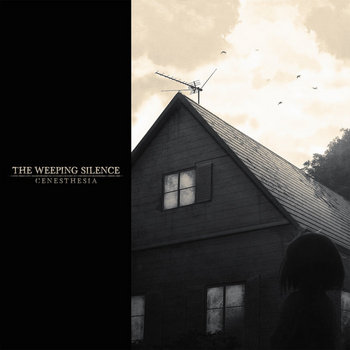
Speaking of nights, I feel I want to touch on the album art here. A lot of this album's music is about the nighttime and darkness, both literal and emotional. But the album art depicts a figure looking at a bleak house...during the day. It is clearly daytime, and the cloudy sky is rather starkly bright. So perhaps none of this is really about the night of the world, but instead the night of the soul, which can carry through the light of the day. I often like to think of a house or other architecture as a metaphor for the container of the true inner soul in my own work, so I feel rather connected to this imagery.
And then we go past that house and that sky, with "Vespertine Moon II", leaving the piano (and thus the self, in my interpretation) fully behind. Slow, distant pulses of quiet strings allow a space within space to float for a while, and there's something serene about this. I kind of wonder if there is a Vespertine Moon I, but I don't think that is within the scope of this album, so I will discard that thought. Who am I to question such vespertine moons? But then...the self comes back, with sparse piano moving in during the very end of this track. In a way, that's kind of the opposite of how "Monochromatical" worked.
"I'll Leave the Lights on Just in Case" begins with a kind of similar piano as "Monochromatical" but much less present and much more ghostly (it's not the same notes, but the movement is reminiscent). We've been through a lot. And I feel that this also connects to that album art choice of a bright sky. Keep the lights on around the dark house, just in case. The piano feels like it is slowly falling into a cushion of its surroundings and itself.
So, was that a calmness of death, or the death of the soul? "The Funeral I Deserve" is quite a dour title, and I suppose the music isn't exactly hopeful either for this track. It is definitely more dissonant than a lot of what has happened thus far, with the piano feeling like it is collapsing within its bounds into the tension of the strings calling from afar. Both this and the previous track have a feeling of falling, but this one feels a lot less gentle, though it is still slow and and gradual. And by the last minute, we are met with relative peace, as everything resolves into more stable chords, as if the soul has finally truly accepted its fate.
Finally, we have the closing track, "As the Weeping Silence, So Profound". A low rumble drone devoid of recognizable piano or strings, it feels as though we really are in the ground now, either metaphorically or literally. This is the beginning of eternity, and where we leave this tragedy.
So.
Overall, this is such a well-thought-out, well-executed piece of dark ambient and contemporary classical music. The consistency of the piano and strings coupled with the dynamic narrative that was sculpted using their composition and even just their presence or lack thereof throughout really made this an engaging listen. I think it does require a base level of patience, because it is very slow and gradual, but it is certainly not dull, and I feel it contains a lot more emotion than a lot of other dark ambient type things I've heard in the past. I think I will use this album as an example of how to do this well. And I encourage people to buy it. It's only listed for a dollar and I will be paying more than a dollar for it.
I hope the artist, Cenesthesia, is doing well. I know pieces of music can be fictional, but I've made things in this area when I was not in the best place emotionally and I hope for the best for them if they're feeling hopeless. But I heard the light kept on in that darkness. And even if that doesn't apply to the artist, I think that could apply to other listeners who feel seen by this in some way. There is catharsis to be found in even the worst misery, and there's something on the other side of it, not just the grave.