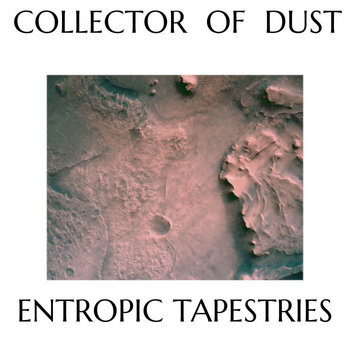
Today I find myself writing about an album situated rather comfortably outside of convention: Collector Of Dust's Entropic Tapestries. Self-described as "chambergaze," it combines shoegaze, post-rock, and drone centered around glassy, soaring bowed guitars for two songs which run for just over 25 and a half minutes each.
The first of the two epics, "Veiled In Eternal Winter," opens with guitar lines indicative of the album's overall feel over gradual cymbal hits heralding a beginning. Once a more concrete drum beat comes in, the guitar takes on a lovely melody propped up over a vast, spacious atmosphere. The vocals are dramatic yet measured in delivery, buried a bit in the mix which comes off as intentional enough to not be a detriment; that said, the performance is good enough that I wouldn't have objected to the voice being more clearly audible. As the song progresses past the first verse, the drums get slightly more intense, feeling somewhere between hypnotic and triumphant under the constant stream of sustained guitar melodies. It is a song with a constant, slow feeling of transformation that is easy to get absorbed by, as if enveloped by a snowstorm.
The song's arrangement and general soundscape remain largely the same for the first 11:30 or so, before pulling back to an arrangement reminiscent of the beginning but now feeling less like a starting point and more like a break or respite. This section has a nice sound to it but admittedly drags on a bit too much for my taste; with this kind of music there's a very delicate (and largely subjective) balance to how much repetition is present (as well as what kind of repetition it is). This break gradually morphs into a new section without drums that feels like a new beginning-point. As it progresses, the dissonance slowly creeps up and back down, morphing from feeling like a beginning to an ending so subtly as to be barely perceivable until it has already happened at which point it's clearly present. The atmosphere is evocative of the sight of an old home disappearing over the horizon when leaving it for the last time, unsure of what is to come but uncomfortably sure of what came before.
The second and final song, "Waltzing Along The Precipice," opens with a dramatic, tense chord held until the drums eventually enter. The somewhat quick 3/4 drum beat feels like a strange fit for the overall textural palette at first but I'm inclined to feel that it actually works well. The vocals are, as on the first song, excellent here, and as a bonus feel more clear and present in the mix. The transition into the beginning of the chorus feels somewhat awkward at first but once it establishes the melodic and harmonic content it becomes one of the high points of the album. The song keeps gradually growing and shifting until it lands on a long chord from which the drums drop out, only to return with a new, unsteady-sounding pattern for the remainder of the song's runtime. An interesting trait of both songs on this album is that, rather than emotions or events, they are evocative first and foremost of landscapes, which is an uncommon and difficult result to achieve in a way that sounds so effortless.
A common thread with these two songs is a similar relationship with attention to how I hear some people talk about certain areas of jazz or classical music: they are best enjoyed either by giving them full, undivided attention, or as background listening while doing something else; partial attention is sufficient neither to appreciate the nuance nor to subconsciously absorb the atmosphere.
Given the songs' repetition, gradual progression, long runtimes, and largely constant arrangements, Entropic Tapestries is definitely not for everyone, but those who are inclined to enjoy this type of music will find it to be a truly excellent pair of songs.