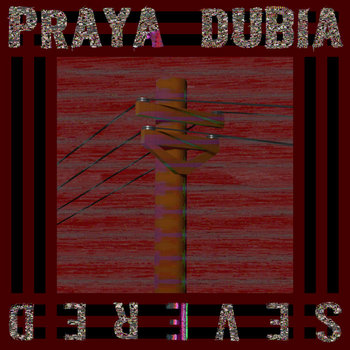
On a surface-level, this may sound like pop with simple, naïve melodies—which mainstream pop is all about [I suppose]—but this goes deeper than that, beyond the mainstream, adding a haunted quality, slightly dissonant, distorted, ghost-like, and the vocals add to that, even if I also think that the vocals are the weakest part—except in the last track, but I'll expand on that later. It's like pop, but haunted, fitting the (perceived) theme of alienation (suggested in the album description)—one of two themes, I should add, of which the other would be a sense of positive development, of things getting better despite a bad start, a sense of optimism (as declared by the artist). There's a clear wish shining through, the wish to carve out a space for oneself. There are also clear deviations from the "pop" with more aggressive sidesteps, danger tunes, and glitchyness (for example in track #3, image). Some clearly competent piano-playing in track #5, remnant. If I had to pin-point a genre, I would call it something like "industrial noise-pop".
So, the singing, I'm not sure what to think about it: On the one hand, it sounds a little out of tune—despite the pitch shifter/intonator(?) effect—or thanks to it—and a bit mumbly at times or staccato (as if spoken only with great difficulty(?) or more spoken than sung), most prominent in the first track, ghost story. On the other hand, the singing sounds fragile, distorted, just about to break and maybe that is the point, which makes me want to quote Flavigula quoting a Bob Drake:
In my opinion a piece of music doesn't "require" anything except that it does what it does because whoever made it did it that way.
Just like Flavigula's Kredenc Kopců, this release is growing on me. A sense of familiarity slowly approaching and the vocals become an instrument among other instruments.
For me, the vocals worked best in the last track, which brings me to the other theme, that of positivity—or, rather, optimism—going from alienation to finding one's place in the world—or finding one's voice… The more aggressive singing style works wonders together with the added distortion, and it fits the overall punk attitude better. Did I just say "punk"? Yes. While this isn't punk entirely or formally, it has a sort of punk attitude, like doing things you wish to do despite what any nay-sayers might say, despite being told you can't, and keep on doing it—no matter how much duct tape it takes. You just do it fucking anyway—because you want to, because you need to, because there is no not doing it. It might not be easy, but that's the way it is. The last track is a "possibility of an island" in a sea of unfamiliarity.
Other moments where the vocals step up and out: parts where the artist does their own backup vocals accompanying the main vocals [at least that's what it sounded like the first time I heard it, although now I can't find it again, but maybe track #6, sphere joint?, and a bit in track #9, aberration], cool bit at end of track #5, remnant, etc… I think it's mostly in the quieter, softer parts that I find the vocals getting a bit too monotone or dry and not working as well as in the spoken word parts or the louder, harsher, more dramatic parts, where the singing/vocals instead excel and emotions shine through more prominently, having a clear sense of rhythm and drive (for example in track #7, eulogy, track #9, aberration, or track #11, angel heart recycler, just like it does in the last and favourite track, rescue, as already mentioned—including the quieter parts). Even in the vocal parts I like less, the distorted parts help making things less monotone and more emotional. [This paragraph is getting a bit messy, but I hope it still makes sense. [maybe what it really needs is to be a list :) ]]
Reading the written lyrics is where it all gets real real [as if it wasn't real already, but anyway], for example in the following short excerpts: First track, ghost story:
and as the sunset flickers \\ the world dissolves again \\ only a blinding streetlight \\ a moth to flame \\ there is no after \\ only sickness \\ in everything and wrong world: i wanted something to find me \\ pulled out before i realized it \\ so ashamed of longing for warmth
Also, note the "i" not being capitalized; feels significant in its insignificance. Actually nothing is capitalized, but the "i" stands out.
and sphere joint:
we take our broken form \\ and fly \\ comforted by the rot \\ and ash \\ at least it still feels real \\ for now
half:
there was never any fear in your eyes \\ of the parts of me that barely survived \\ you taught me how to not hate what i yearned to be
and last track, rescue:
years later \\ she realizes that she can never go back to her old life \\ and it brings her such relief
Taken as a whole, I think this album is doing a good job at conveying the struggles, the quiet moments, the drama, the outbursts, and the becoming, but also the ending with an island found.
★★★
Footnotes:
- Bob Drake is a Usanian avantgarde musician (born in 1957).
- I haven't been able to confirm the Bob Drake quote, although that doesn't make it ring any less true or noteworthy.
- I woke up early today and started thinking about this release on a conscious level—after having thought about it subconsciously for longer (my first set of notes were from two weeks ago).
- At one point, I had a bit of microsleep, because waking up too early and yet no breakfast, and dreamt I was standing in a tall building on a higher level, while looking out the window down at myself also standing outside on the ground. In a way, I was my own daughter or child or maybe a younger self. The other me had a black briefcase, which was transferred like a quantum-entangled electron to also be carried by my higher self. The briefcase was of utmost importance. This all took place in only a few seconds, which is how long the dream lasted.