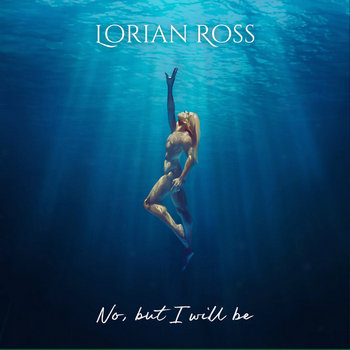
Sometimes I encounter an album that is, broadly speaking, adorned by stylistic markers that I am familiar with individually but are combined in ways that make them feel new and fresh. Lorian Ross's No, But I Will Be is one such album, and a very strong showing at that.
Opening with the title track, there is an immediate immersion in pretty piano patterns with a range of synth and string textures floating around before swelling into a hopeful-sounding orchestral soundscape. It has a very distinct feel of an intro track, reinforced by its brief runtime. What immediately follows, "The Singularity," is where the album's overall style becomes apparent: heavy guitar riffs, uplifting melodies, and a generally "rock" feel while being melodically distinct from what rock music usually entails. A high point here is the vocal performance, alternating between gentleness and force with impressive control over a wide range. The chorus here reveals the first appearance of a recurring stylistic assembly, with melodies and vocal delivery reminiscent of power metal but instrumentally comfortably still in the realm of alt-rock.
The third track, "I Hope You Find Your Way," opens with a verse using vocal arrangements reminiscent of the Gabriel Construct before bursting into a soaring chorus. The song continually feels like it's building to something but pulling back, before finally cutting loose at the bridge and moving over to a solid, very reasonable guitar solo. "Failure for Now" follows, with a riff reminiscent of math rock but without the clinical feeling that sometimes comes with such techniques. Once the chorus, again reminiscent of "rockified" power metal, unfurls from under the verse, it leads to an overall atmosphere I can't come up with any better descriptor for than that it sounds verdant. I am sorry for not writing something better. It isn't a song that particularly appeals to me personally but from a more objective standpoint I have a great deal of respect for what's going on here.
Up next is "Do Something," starting with more electronic instrumentation and processed vocals leading to an overall uneasy atmosphere. It's a very patient song; the first chorus ends around the 2:30 mark, and at no point does it feel like the song drags on at all. The way it grows slowly and shifts toward more open, organic-sounding sounding soundscapes as it progresses is excellent. "Childhood Eyes" is a change in the opposite direction, a bittersweet and nostalgic acoustic-guitar-driven song with orchestral textures swelling and receding behind delicate, beautiful vocals. Even as the drums and electric guitars become more present it retains the same emotional palette as before. I ordinarily don't particularly like acoustic songs in the middle of rock albums but this is not only an exception but one of the high points of the album.
"The Next Generation" immediately brings back the heavier sound, opening with a bluesy riff backed by electronic textures. The fade to piano and strings after the second chorus feels kind of awkward, which is unfortunate since everything else about the song is so good. It's followed by "World of Wonder," immediately bright and energetic with a cool guitar lead and rhythmic patterns reminiscent of, broadly speaking, "electronic music." It's a great song but I don't have much insightful to say about it. This is followed by "Keep the Faith," opening with a choir figure before launching into an uplifting rock song that again takes cues from power metal in its chorus. Following the second chorus, the song explodes into a heavy guitar-driven bridge with rough, forceful guest vocals by Luis Vasquez. Putting a guest vocalist on one song in an album that otherwise has one primary vocalist is a bit hit-or-miss but in this case it suits the song and gives some nice variation without feeling too out of place.
And then we arrive at "Find Your Light," a consciously hopeful-sounding song with prominent horn interjections throughout the chorus. My initial notes describe it as "basically just a really fun song" which is more or less the best way I can concisely describe it; it's uplifting, slightly silly in moments, without being particularly jarring or awkward among the more serious songs in front of it. Up next is the beautiful penultimate song, "Sad Heart Singing for Joy," opening with fast quiet piano before bursting into perhaps the most uplifting passage on the album. It's cathartic, comforting, reassuring, and one of the most well-placed songs I've encountered in a long time; any earlier on the album and it would have been great on its own but nowhere near as impactful. The album's conclusion, "Who We Have Become," starts out minimal and stringy before swelling into a sweeping, dramatic orchestral soundscape that gradually shifts its instrumentation about. It's different from the energetic rock atmosphere of most of the album, but it feels like a sensible ending-point regardless.
Overall, Lorian Ross's No, But I Will Be is a truly excellent rock album balancing high-energy, soaring passages against introspection and natural-feeling textural excursions, held together by a stellar vocal performance. It's a serious album that is at the same time unafraid to be hopeful in moments, with an innocent sincerity uncommon for music with this level of refinement.