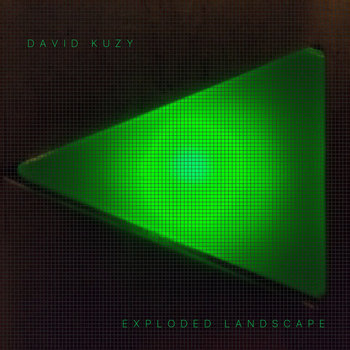
Today I find in my hands an album whose sheer singularity makes it a challenge to discuss adequately: David Kuzy's Exploded Landscape. It is most readily describable as a "guitar album," though that descriptor leaves ample room for misconception.
While the guitars are the main focus, both universally placed at the front of the mix and given the central roles of the compositions, there is no focus on virtuosity or flashy technique; while some passages are no doubt difficult to perform, they are in service to the music rather than merely a means of demonstrating technical skill. The percussion, when it's there, mostly provides light beats or intermittent interjections, adding texture to let the guitars breathe but never taking the focus for itself. Similarly, occasional synth presences consist almost solely of simple lines to give the arrangements more depth. While sometimes very sparse, I wouldn't necessarily call the music as a whole "minimalist," but rather streamlined or efficiently arranged.
As for the composition, it's equally hard to categorize; tonally and rhythmically, there are bits of jazz, Southwest Asian folk music, blues, even classical sometimes, but as a whole it is quite decidedly none of those genres. The music has an incredibly physical character, perhaps best demonstrated by the aptly-named trio of pieces spread through the album's first half, "Spike Field," "Landscape Of Thorns," and "Spikes Bursting Through Grid." Each one feels sharp, though they convey this form in different ways: the former relies on bright high-pitched back-and-forth passages in rapid succession, the middle uses dissonant, sparse guitar lines with heavily-accentuated attack to give every note a sharp, pointy feeling, while the latter does so with its stop-start lead lines.
Something to bear in mind is that, unusually for more experimentally-minded music (at least as far as I have encountered over the years), this album in general gets more approachable as it goes on. Between the slow chord-driven body of "Menacing Earthworks" feeling like an interlude stretched to nearly 6 minutes, the aforementioned dissonant sparsity of "Landscape Of Thorns," and "Blown Up And Out's" swelling, reverberating waves of noise (as beautiful and fascinating as they may be), three of the first four tracks are among the strangest and most abstract of the record, with most of the runtime following this point, while being unusual in its own ways, shifting more toward more concretely-formed and almost songwriting-like compositions.
As compelling as much of this album is, a point of criticism I have is that there are moments where the guitar-playing sounds lacking in confidence or drifts a bit; if it was music with a more balanced instrumental landscape I wouldn't mind, but given that the guitar is the main focus of the arrangements, it does become distracting at a small handful of moments throughout the album. On the other hand, there are also moments where this lack of polish is to the benefit of the music, giving it a more urgent or earnest feeling.
In the end, this is a fascinating album, with unique writing and arrangements coming together to create music that is remarkably physical and evocative of forms, structures, shapes. It's a guitar album, but antithetical to what I usually find fault in guitar music for. It's experimental, but also remarkably practical and willing to forego weirdness if it means sounding good.