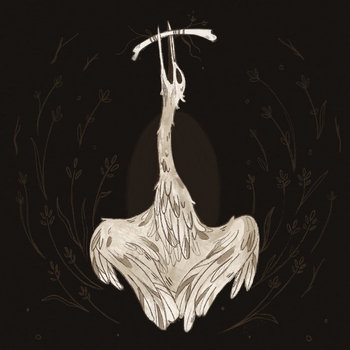
Here we have a compelling twist on a format I had never before witnessed with such commitment and nuance: MEGAFAUNA's self-titled third album. Described as a statement of identity, it is something of a tour de force of dark electronica, bouncing between dubstep, EDM, techno, and industrial music peppered with excursions into other genres and drenched in haunting atmospheres with a striking clarity of intent.
From the opening "Your Bones Are Always Wet," the music is remarkably intentionally-paced, with sound design and production that remain at a high level of quality through the album. A common thread between a number of tracks is the use of swelling, hazy chords as a harbinger of escalating intensity, fading in before being overtaken by metallic bass and pounding beats.
Equal in importance to the beats in establishing and maintaining a sonic identity is the heavy use of soft, spacious synth textures at times drifting into ambient territory, sometimes left to their own devices and sometimes flitting about the corners of beats that would threaten to crush them in the hands of a less-skilled producer but here form a symbiotic, nocturnal landscape. It's a constant enough balance that it becomes a more fundamental aspect of the music than something simply tacked on for the sake of variation.
As easy as it may be to focus on the beats or atmospherics on an album like this, the moments with prominent melodic leads such as "Lost, Found, Discarded," the later portions of "Ghosts Are Born of Trauma and Violence," potential high point "Stories Heard but Not Recalled," and the nocturnal, plaintive "Thirty One Point Nine" all clearly demonstrate MEGAFAUNA's ability to craft infectious-yet-bittersweet lead lines.
Two other standout tracks, "Honeybees" and "I Think the Bats Might Come," both carry with them some stylistic diversions; the former is a beautiful electric piano piece with a more organic-sounding textural palette than the tracks surrounding it, while the latter is formed around a groove that shares some DNA with recently-emergent mid-tempo metal cultivars.
It's hard to find much about this album to criticize, though I am inclined to say that a few of the tracks overstay their welcome. This only applies to a small handful of them ("It Gets So Much Worse" and "Her Still Singing Limbs" stand out most significantly here), but it is still worth mentioning, given how good the album is in general.
As a whole, MEGAFAUNA's self-titled record is compelling, emotionally powerful, and remarkably well-produced. It is an album drawing from a range of styles and tendencies, molded into a cohesive whole with a strong sense of artistic identity.
