To start, some historical context is warranted here: in 1968, Wendy Carlos released Switched-On Bach, a collection of synthesizer renditions of compositions by Johann Sebastian Bach performed on a Moog synthesizer. This record ended up being immensely important for two reasons. First, it was an early instance of centrally using synthesizers in music that prioritized sounding good, rather than merely exploring what was technically possible. Second, somewhat opposite the first point, is that it was a way of making Bach's music feel accessible to wide audiences. This inspired countless imitations, some being good but the majority of which reduced themselves to cheap gimmicks or purely intellectual exercises far less interesting than they claimed to be.
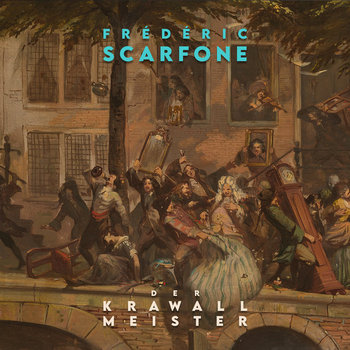
Enter Frédéric Scarfone's Der Krawallmeister, an album primarily consisting of modernizations of Baroque compositions (including 3 of Bach's) that namechecks Wendy Carlos as a central influence. An important point here is that Scarfone, like Carlos, displays a willingness to let the music sound good, approaching it from a place of genuine love for the compositions.
The stylistic directions of the adaptations are diverse, with Autokraton (adapted from de Visée's Allemande "La Royale") being rooted in dubstep, before shifting to the nostalgic, high-energy dance beats of "Der Krawallmeister" (one of the aforementioned Bach adaptations, this one based on Prelude in D minor from the Well-Tempered Clavier) and the rock-solid hip-hop landscape of Vindication, built out of of Purcell's Abdelazer Rondeau.
Despite the range of styles present, the quality of the execution never wavers, and the whole never feels like it lacks cohesion. My one complaint is that it feels like something is missing toward the end, like the overall experience would have benefited from one more dramatic moment before reaching its conclusion.
Something effective about the way this album is put together is that, because the first three tracks establish a sonic and thematic identity so strongly, there can be more tracks than usual that go in different directions later without spreading the album thin. The rendition of Bach's Prelude in C minor (transposed to D minor here), for instance, is played almost entirely on an acoustic guitar. It's a slower rendition than many I've heard, working more as an interlude than a prelude. Similarly unique is the following "Le Retour de la Guillotine," being both the only track with entirely original music and the only track with vocals.
Overall, Der Krawallmeister is simply a really good album. The adaptations are excellent across the board, the original composition is both good and not at all out of place, and the entire album effectively conveys its themes of revolution despite being mostly instrumental. Finally, and in some ways most importantly, it's a lot of fun. The album's description reminds us that many of these compositions were (or were related to) music meant to be danced to, and the tracks themselves show that Frédéric Scarfone understands that fact very well.