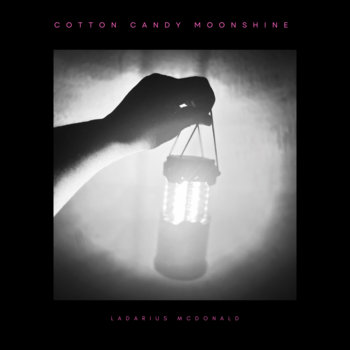
Ladarius McDonald's Cotton Candy Moonshine is an album that is far more than the sum of its parts, a statement that also applies to each song individually. Ordinarily when reviewing an album I tend to focus on giving most of the space to track-by-track discussion, and I will do some of that here as well, but afterward I have more to say about the entire experience than usual.
The album opens with its title track, beginning with a plucky bass loop eventually joined by a second, noisier bass and a two-note piano loop underneath clear, earnestly-delivered vocals. The track's tension gradually build as each new layer recontextualizes the last, culminating with twin guitars and drums propelling the track to its ending. My one criticism here is that the song ends on an awkward fade out; given how much everything builds the ending feels oddly noncommittal.
The second track, "Throw in the Towel," begins with a pretty piano figure that gradually gets darker and wobblier as it progresses. After a while the arrangement is joined by crunchy guitars and straightforward, powerful drums rounding out a 3/4 - 4/4 polymeter. It's another instance of new layers giving new character to earlier lines. The next two tracks, "Turning" and "Umbilical Cord," are both very repetitive in their structure, but are both absolutely good enough that it isn't a detriment in the end. The former of the two is built around a high-pitched guitar pattern under gradual, twisting vocals, while the latter builds off of a spacious synth flitting side to side over a simple yet effective bass groove.
"Number" brings the energy back up, built off of a slow piano line and noisy guitar stabs stacked around a drum beat that carries a feeling of focus and intense unease. As the song continues, the atmosphere progresses from tense to downright suffocating, held together by whispery synths and somber vocals. This is followed by "Spiders," opening with a beautiful piano line over a sparse beat and light synths. Once the vocals enter, the piano gradually becomes darker until it takes on a character similar to some more ominous strains of 21st-century jazz.
"Good, Alright" is formed of a gradual bass loop under noisy rhythm guitar interjections, wobbly, dissonant synth backings, and a vocal performance that acts as a point of stability binding the entire track together. The final track, "In Our Shared Garden," opens with a slightly unsteady-feeling drums-and-bass groove and vocals that feel subtly gentler than on previous tracks, and almost slightly tired. Eventually the drums and guitar combine to take on a blurry, dizzying quality, like a whirlpool in slow motion. Toward the ending, the drums switch to a much more straightforward beat, and the whole atmosphere is that of a proper final statement to the album.
Stylistically speaking, this is a very interesting album overall; there are bits of funk, alt rock, indie rock, R&B, art pop, jazz, and more, all blended into a whole that feels cohesive enough that it doesn't really feel like a "fusion" when listening. The arrangements stay consistent between tracks, mostly built on some combination of voice-drums-bass-two guitars-piano-background synths, which helps the songs sit well next to each other across different moods and stylistic excursions.
Another stylistic element that necessitates mention is the song structures: nearly all of them are based around a collection of looping instrumental figures gradually joining one after another, constantly giving each other new harmonic and rhythmic context. A piano line that feels serene may turn terrifying when joined by the guitars, an uneasy bass figure could turn into a solid groove when joined by the drums, and the like. It's a fascinating way of composing music and to see it done so well and with such consistency is very impressive.
Perhaps the main draw here, if a specific individual presence were to be highlighted, is the vocals; Ladarius McDonald has an incredible voice and, on top of that, is far and away a good enough singer to give every moment the correct balance of emotional intensity, softness, and phrasing to maximize impact.
In the end, Cotton Candy Moonshine is a tense, moving, compositionally captivating album tied together by excellent vocals and a singular, clear artistic vision. The end result is something new to me but that carried an immediacy that usually arises from familiarity.