So, how do you review an album whose artist advises not to listen to it in one go?
The ‘Experiment/Weird’ category on _nsigned is always going to be a challenge! I’ve dipped into a few submissions only to shy away, unable to form more than a sentence of critique. And it seemed my thoughts on Paul Rubenstein’s summoning ALL the demons (2026) were only going to consist of “Good to play out loud on the bus when the clown next to you starts scrolling through instagram without their headphones on!”.
But then I read what Paul had written about this album and the next time I listened something revelatory happened...
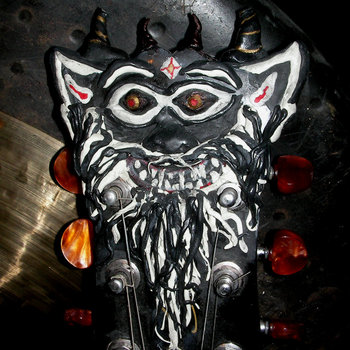
The music on the album is all played by Paul on an two stringed instrument he invented called the Mechanical Monk. Motors vibrate the strings and it is played with two metal slide rods. You hear what it sounds like on track 2 ‘summoning all the demons part Y’ – a tremulous drone that sounds like a throat singer doing an impression of a turboprop aeroplane engine.
This ‘naked’ monk sound is my least favourite of the five tracks, but it is the foundation for the other four tracks. Here the output of the monk is turned into MIDI and sent through some synth processing, It enhances the sound considerably for the listener I think. I presume that the processing is different every time a take is made as tracks 1 and 4, ‘summoning all the demons part Z’ and ‘summoning all the demons part O’ are variations on track 2. Tracks 3 and 5 are ‘demons dance’ and an alternative timeline of ‘demons dance’.
Paul explains on his bandcamp page that he regards playing the mechanical monk as meditation and the music he has produced should be used for meditation: ”I don't believe that music for meditation should be soothing and serene. Successful meditation requires remaining alert. That's what this is meant to promote.”
So, OK, I thought I’d give it a go. Comfy chair, headphones on, eyes closed, put on Part Z. Whoooaaa! I had never expected this! The monk drones turn into wayward horns, like a swarm of insects leading you on through squeaking glimpses of a fragmented orchestra. I find myself concentrating on individual sounds, my mind is emptying, it is a surprise, completely unexpected: meditation unlike any I have tried before.
After around 10 minutes I felt calm enough to stop listening and open my eyes, refreshed. It is a process I’ve repeated on the other tracks, usually stopping naturally around the same time (all the tracks are around 18 minutes in length) - though I did see demons dance all the way through once, and I haven’t always started at the start. The 10 minute mark isn’t the point where I can’t take any more, it is just where I feel my meditation is complete. It has, as I said, been revelatory! Part Z remains my favourite, but I can’t explain why. Parts Z and O do differ, as do the versions of demons dance, but I don’t have the words in my lexicon to describe how, you will have to hear them yourself to ascertain!
It would be crazy to want to listen to summoning ALL the demons (2026) all the way through in one sitting, or playing it in the car. You are not going to hear it on the radio anytime soon. It may have uses annoying people who seem unable to use earphones on public transport, this remains untested by me. But, and it is a big but, the big reason to listen is that the tracks on it contain amazing and unusual catalysts for positive meditative experiences. As such I’d recommend you give it a try, just like I did.